PAGEANT - "Education is the future"
Pageant Loans - kick-starting small businesses
How Pageant's Loan Scheme Works
Many people in the world's poorest countries have benefited from micro-loans enabling them to set up their own small businesses. Pageant's Loan Scheme differs from most of these, in that we only lend to groups of women in Gambian villages. Each group typically has six women, each of whom is helped to set up her own small business. Members of the group can support and encourage each other during the difficult early days. The group is looked after by a respected village woman, who keeps track of the loans, and reports back to Pageant. The big difference with the Pageant scheme is that we do not expect to get the money back. When the first group repay their loans after six months, the money becomes available for a further group - and so on.
Pageant is planning to roll out loan schemes in more villages across The Gambia. Each scheme takes some time to set up, because the critical requirement is a respected local lady to act as co-ordinator and run the scheme. If you would like to help, then please make a donation, which we will then use to help finance the next scheme to get started.
Bakalarr Loan Scheme - started October 2006
Pageant's first Loan Scheme was at Bakalarr, and came about after a series of events, and we think it is worth outlining its history. The Bakalarr scheme took a while to set up, and the nearby Sika Village Market loan scheme was actually operational first.
Pageant had been assisting a Women's Group in the Village of Busumbala by funding literacy and numeracy classes which helped them run small businesses such as vegetable growing, tie dyeing and other crafts. However, at that stage, Pageant had not actually provided help in starting any small businesses.
When Bakalarr headmaster, Bakary Gitteh, visited the UK in the summer of 2005, Pippa showed him a video describing a micro-loan scheme started by two lady missionaries in South Africa. Their idea was to lend a small sum of money to each of six ladies in a community, so that they could each start a small business. (For The Gambia, we thought that 1500 Dalasis would be the ideal amount.) Each lady had to come up with a business idea that she felt she could manage and that would be supported by the community.
Once it was agreed which ladies would get the loans, they were lent the money, interest free, for a period of six months. They had to agree to pay back one sixth each month, (250 Dalasis) until at the end of six months all had been repaid. As long as ALL the money was repaid, it could then be lent out again, to six more ladies of the community - and so, it could be treated as community money, as long as it was always repaid.
Bakary was fascinated by the idea and had watched the video several times. The main drawback from Pageant's point of view was that it needed a local woman to be the go-between - a woman who commanded the respect of the local ladies and who could also talk to us and understand how the scheme was to work. A man would not do. So Bakary said before he left that he thought that his wife, Mariama, might act as our go-between and he would discuss it with her. However, he had not mentioned it again, so we thought she had not been keen on the idea. We had also mentioned the scheme in a few places, but no-one had taken it up.
The Bakalarr scheme was started during Pageant's visit in October 2006, when a very large number of women crowded into one of the Bakalarr classrooms to hear the details of how Pageant loan worked from Pippa and Mariama.
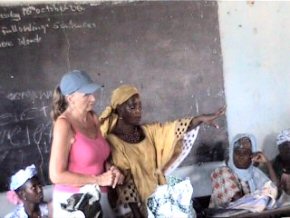
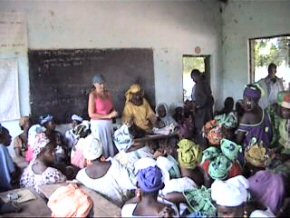
On her visit in February 2007, Pippa found that the first group in the Bakalarr scheme was just coming up to completion. Mariama assured Pippa that the women were all paying back the correct amount and on time. Currently (June 2009) the Bakalarr scheme is on its eighth group of women...
As it happened, the loan scheme at Sika, also coordinated by Mariama Gitteh, came into operation before the Bakalarr scheme...
Sika Women's Village Market
started 2005
One of the most successful and long running loan schemes is a village market run by the women of Sika on the North Bank. This was started with a Pageant loan in 2005, and is still doing very well. Pageant has now helped with funding for a new market place. The market is in use every morning and all the local women have the opportunity to trade each day. They say it has transformed their lives.
Read the full story of Sika Women's Village Market

Gunjur Loan Scheme - started October 2009
Pageant started a loan scheme in the village of Gunjur in the southern part of the Gambia. The Sheik Hatab Memorial Nursery School has an active "Mothers' Club" associated with it. On a Pageant visit in April 2009, members of the Mothers' Club said they were keen to participate in a Pageant Loan Scheme, and Pippa was introduced to Binta Jammeh, the Home Science teacher of Gunjur Upper Basic School, who agreed to be Pageant's go-between for the village women. In October 2009 an inaugural meeting was held and the loan scheme started.
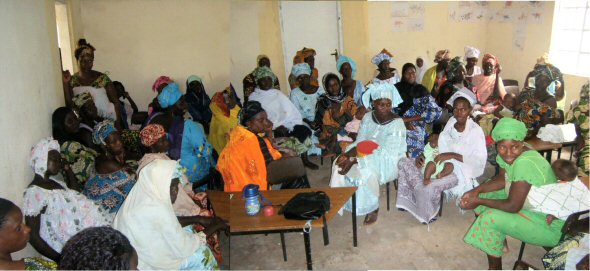
Gunjur women at the inaugural meeting
The loan scheme was run on similar lines to those in other villages - i.e. Pageant lent 1,500 Dalasis to each of six ladies, who would each come up with a business idea that she felt she could manage and that would be supported by the community. Pippa met a large group of ladies who were interested in the loan scheme, and the go-between, Binta Jammeh, who spoke excellent English and was able to translate between Pippa and the Gunjur ladies.
Binta decided to lead from the front and took one of the first 'start-up' loans herself. She and the other five 'start-up' ladies explained their ideas to the group and all were supported with enthusiasm
Binta decided to start a soap-making business using oil and sodium hydroxide (caustic soda); two other ladies were buying spaghetti, vegetables and oher items such as dried fish in quantity to make school meals, one at the nursery school, the other at the Upper Basic School; another was buying fertilizer in bulk - some to sell in small quantities to small-time gardeners, the rest to use herself to improve her own crops; the last two ladies were buying various provisions in bulk and selling them in small quantities.
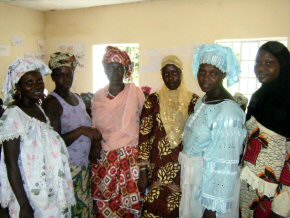
The 'start-up' group Binta on extreme right
Jambanjelly Loan Scheme - started February 2012
A Pageant loan scheme was set up in the village of Jambanjelly (sometimes spelt Jambanjali), by members of the local Women's Union, with Mai Baldeh as coordinator. The first group of 6 ladies took their loans in February 2012. They are now on their third set of ladies and most of the members of the first two groups are still trading.
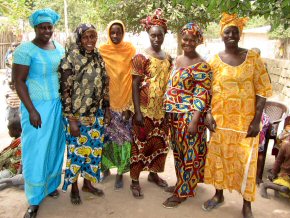
the first Jambanjelly loan group
(coordinator Mai Baldeh 2nd from right)
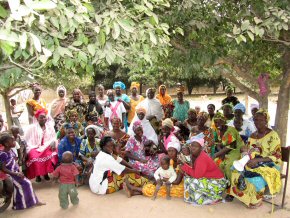
Jambanjelly women who will be taking part
in the loan scheme
Siffoe Loan Scheme - started March 2013
A Pageant team made one of their regular visits to The Gambia in March/April 2013, posting their news on the Pageant News Blog. For your convenience, we have collected their blog posts here. At the beginning of this visit, Pippa and Tina travelled to Siffoe to help set up a Pageant Loan Scheme, This is Pippa's report:
"Tina and I had a really exciting job to do on the day before Frances at al arrived - we were going to a village in the southern part of The Gambia called Siffoe to set up a Pageant Loan for a women's group based in and around the compound (Kanteh Kunda) from which Momodou Kanteh comes. Pageant members who come to our summer parties will have met Momodou, as will our container-packing team - he has visited UK several times at the invitation of various people, and has always been keen to help with any Pageant event or task while he has been here.
(Some background: I had visited Kanteh Kunda during our February trip - Ian had come home by then, and I was accompanied by a couple of Pageant members, Delia and Michael, who happened to be staying out there at the time. We had gone to meet the members of the group as well as the key lady, Tombong Susso, who had been chosen to be the link between the women and Pageant - a position of immense importance to the loan scheme, as it is she who has the task of managing the incoming payments, banking them and then, when all have been returned, lending the money to more ladies.)
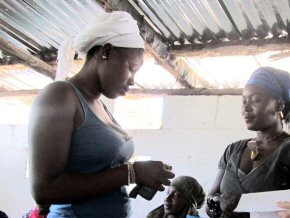
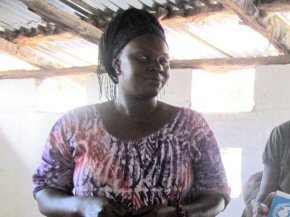
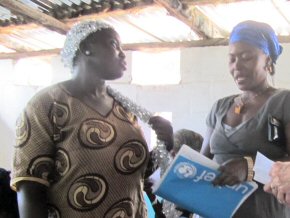
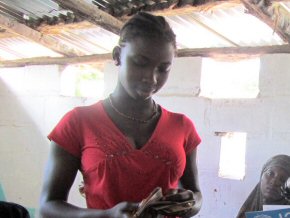
So, Tina and I arrived to find an excited group of women and children sitting in a large shaded area, with Tombong in charge. We went through the formalities and then each of the six ladies who had been selected to be the first to take the loan stood up in turn, to state their idea for a business and how much the finished product would be sold for. The community then had to say whether or not they would support this business, as obviously local support is crucial to the success of the scheme. As the group had been able to discuss all the proposals well in advance, it was no surprise to find that support was given to all six ladies!
- Sahaba Jarju - she would buy vegetables in bulk from the market town of Brikama (about 6 miles away) and sell them in small quantities locally.
- Isatou Kanteh - she would buy the ingredients to make soap in bulk from Brikama and then sell the soap locally.
- Isatou Kanteh (2) - she would buy fertilizer in bulk from Brikama and sell it in small quantities locally. She also hopes to sell some of her crops.
- Ndey Kanteh - she would buy charcoal in bulk from Brikama and sell it in small quantities locally.
- Isatou Susso - she would buy cassava in bulk from Brikama and then cook it in a sauce to sell locally.
- Sariba Kanteh - she would buy the ingredients to make bread in bulk from Brikama and bake the bread to sell locally. She would also sell salt. (This last proposal was greeted with HUGE enthusiasm by the rest of the ladies!)
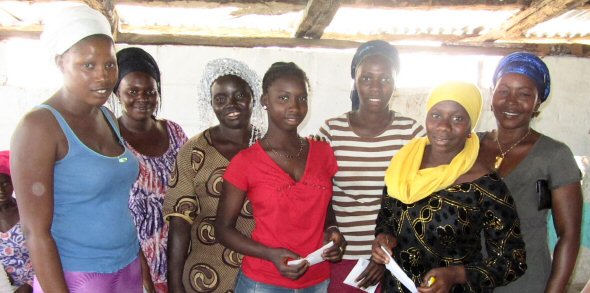
Siffoe Loan Group
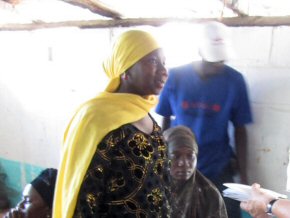
Sahaba Jarju (vegetables)
Isatou Kanteh (soap)
Isatou Kanteh (2) (fertilizer)
Ndey Kanteh (charcoal)
Isatou Susso (cassava)
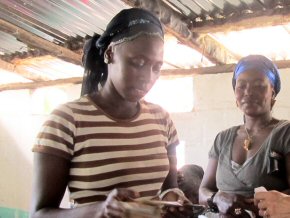
Sariba Kanteh (bread)
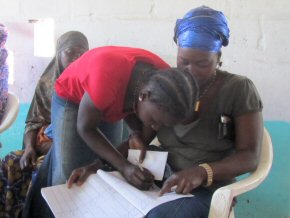
Isatou Susso signing Tombong's book
Having been accepted by the community women, the six chosen ladies then each came forward to receive their money (D1,500 - about £30) and signed for it in Tombong's book. At the end of each of the next six months they will each pay back D250 - after that any money they make will be their own, both to use for their families and to plough back into their businesses. We wish them well - as do the next six ladies, who are already waiting for their turn!"
More Pageant Loan Schemes
Pageant is planning to extend its loan scheme to more villages. What we need are more people like Mariama, Mai and Tombong, who can act as our go-between in each new village. It is important that this person is a female with local authority, who can both command the respect of the village women and be able to communicate well with us and understand how the scheme works. It takes time to find the right people, but they are well worth waiting for, as has been proved by our existing coordinators.
Background - Other Loan Schemes
Micro-loans are for people who are too poor for normal banks to bother with, and are a powerful instrument to lift third-world communities out of poverty. For in-depth information about micro-loans, please see this excellent paper The Promise of Microfinance for Poverty Relief in the Developing World.
Micro-finance schemes operate in many countries of Africa, Asia and South America, but they are particularly common in rural South Africa, where many are coordinated by the Small Enterprise Foundation. Another example in South Africa is Women's Development Businesses (WDB), with microfinance programmes based on Grameen Bank schemes in Bangladesh.
Another microfinance scheme is lendwithcare.org which is operated by the charity Care International. The idea here is for individuals to lend small to moderate amounts of money to selected small businesses throughout the developing world. The lender is then paid back their original investment, without interest, from profits made by the business. When the whole loan has been repaid, the lender then has the option of reclaiming their money or donating it to Care International.
Please Help With a Donation
Inflation means that we now need 1,800 dalasis for each of the six women in a new scheme. So a group of six women needs a starting investment of 10,800 dalasis, or about £180 at the exchange rate in July 2019. (You can check exchange rates here.) We always have new schemes in the pipeline which you can help to finance. You can donate any amount to our Loan Scheme online, using your credit or debit card.

You can donate online using your credit card, debit card or PayPal. This service is provided by Charities Aid Foundation. They add a small handling charge, and also charge card processing fees. If you are a UK taxpayer, they also collect Gift Aid for us, meaning that an extra is added to your donation without costing you an extra penny. [more about Gift Aid] [How we safeguard your information]
Alternatively you can send a cheque by post to Pippa Howard. Old School, Worthing Road, Southwater, Horsham, West Sussex. RH13 9DT, UK. Please write 'Pageant Loan' on the back of the cheque. Also if you are a UK taxpayer, please send us a Gift Aid form to allow us to reclaim UK Tax. Gift Aid allows Pageant to claim an extra from the taxman. Our Gift Aid form is available in Microsoft Word or PDF format.